The Program
The Catholic Steps
Origin
December 7, 2022
On December 7, 2022, Saul Hernandez made a decision: to reformulate the twelve steps of Alcoholics Anonymous according to the teachings of the Roman Catholic Church. The result is a program that is sacramental — rooted in Confession and the Eucharist — and universal, applicable to any attachment, not only alcohol.
The key departure from AA is the removal of Steps 6 and 7 (listing and asking God to remove character defects) to make room for the Sacraments. In their place: Sacramental Confession and the lawful reception of the Eucharist. The Catholic understanding of salvation is not a once-saved event but a cycle of death and rebirth — and the Steps are designed to support that rhythm.
The steps below are presented as Saul formulated and took them. Click any step to read the full explanation.
The Twelve Steps
- I.Admit I AM Powerless Over X
- II.Come to Believe in the Eucharist
- III.Turn My Life Over to the holy Spirit
- IV.Make a List of My Resentments
- V.Share With My Sponsor and Forgive
- VI.Make a List of All Persons I Have Harmed
- VII.Make Amends Wherever Possible
- VIII.Sacramental Confession
- IX.Lawfully Receive the Eucharist
- X.Admit My Wrongs When They Occur
- XI.Continue to Grow in My Relationship With the Trinity
- XII.Go, Therefore, and Make Catholics of All Nations
Whether it be drugs, alcohol, or gluttonous seconds — God allows Satan to tempt us so that we will turn to Him in our time of need. We become stronger than we were before. How does a silversmith know when the metal is ready? When he can see his own reflection in it. That's how he knows. God tempers us, works us, gives us what we can take. And when He can see His own reflection in us, He knows that we are complete.
The verb used in John 6:54 is not the classical Greek verb for human eating, but that of animal eating — 'munch,' 'gnaw' (τρώγω). Jesus was not being symbolic. He was speaking about munching His flesh, the Bread of Life. This is not a metaphorical suggestion, but a condition for life. Around A.D. 107, Ignatius of Antioch wrote: 'They abstain from the Eucharist… because they do not confess that the Eucharist is the flesh of our Savior Jesus Christ.' This is not symbolic language. Embrace the mystery of the Eucharist. You will not regret it.
Whoever eats my flesh and drinks my blood has eternal life, and I will raise him on the last day. — John 6:54
Sacrament: The Eucharist
God speaks through people. Listen to the actual sound waves beating your eardrum. If you are speaking with someone who loves you, chances are you are hearing the holy Spirit speaking through that person. Surrender your will and your life to the care of God as you come to know Him through the Church.
Sacrament: Confirmation
Resentment fuels sin. Making a list of our resentments is a healthy practice. Put it down on paper. If possible, look at your role in the formation of that resentment. You may need the help of another Catholic to show you where your role is. Forgiveness is the path to freedom from compulsion, from obsession, and from sin. You can forgive someone while still allowing justice to run its course.
Beloved, do not look for revenge but leave room for the wrath; for it is written, 'Vengeance is mine, I will repay, says the Lord.' — Romans 12:19
Forgiveness is the key to heaven on earth. Your sponsor will help you with this. Another Catholic can see your situation more clearly than you can. They do not have a dog in your fight. Trust that they come to the table with a capacity for clear vision of your situation. If your sponsor is not a practicing Catholic, gently fire them and move on.
God may forgive you in the confessional. But not your earthly debt. If you steal $50,000 from your company and go to confession, God will forgive your sin — but you must repay the money to fully restore your relationship with God and His people. Make a thorough list. Hold nothing back. A comprehensive list will lead to a proper restoration.
Making amends will fully restore your relationship to God, His people, and more specifically, His Catholic Church. Be vigilant and persevere. It may take years, especially for financial amends. But the price is worth it. You can walk the earth with the self-esteem that comes from doing esteemable acts. Sometimes amends are not possible. The best you can do then is a living amends — doing your best to serve God and His Church wherever possible.
Therefore, if you bring your gift to the altar, and there recall that your brother has anything against you, leave your gift there at the altar, go first and be reconciled with your brother, and then come and offer your gift. — Matthew 5:23-24
As you enter the confessional, you may go face to face or from behind the curtain. Courage is the virtue from which all others flow. Face your priest. Your sins are not as grand as you may think. You are not special. Listen to your priest. Allow him to guide you through a good confession. This is not therapy — it is a confession. Just your sins. There may be people in line behind you. Be respectful of your fellow travelers.
Receive the holy Spirit. Whose sins you forgive are forgiven them, and whose sins you retain are retained. — John 20:22-23
Sacrament: Confession
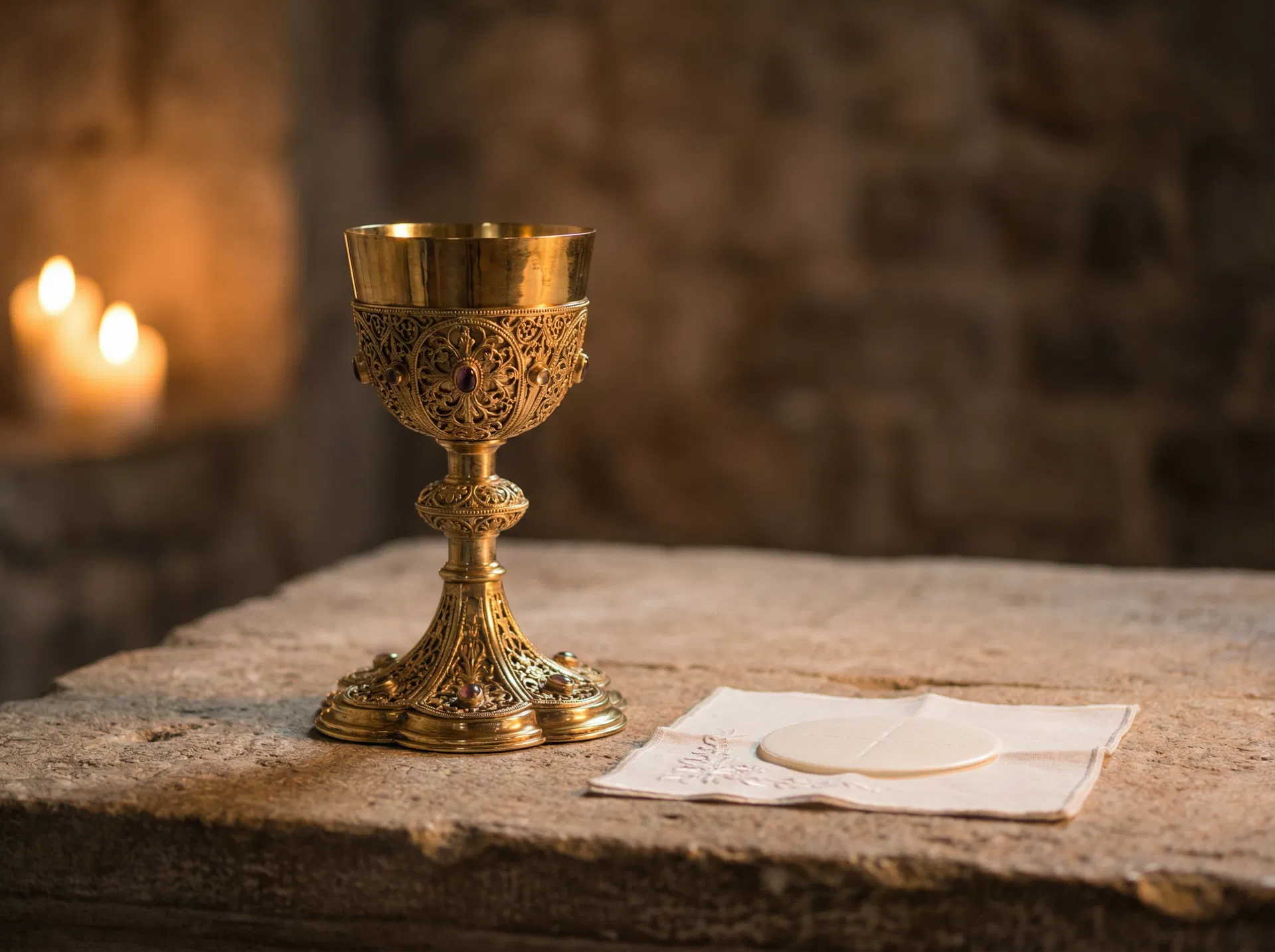
You have made amends to your brother on the way to the altar. You have reconciled yourself to God in the confessional. Now receive Him. Only Catholics in a state of grace may receive the Eucharist. This is not exclusion — it is the integrity of the system. The cycle of death and rebirth, confession and communion, is the engine of Catholic sanctification.
Sacrament: The Eucharist
You are now prepared to admit your wrongs as they occur. You have been armed with the knowledge of yourself and your ability to deceive yourself. You can now recognize it for yourself and make wrongs right, on the spot. This is a power that most do not have. Use it.
Now that you have come to know Jesus in the Eucharist, do not neglect your heavenly Father or the holy Spirit. The reason God comes to us in three persons is because we are not all the same, all the time. Sometimes we need a firm Father figure. Other times we need the compassion of Christ. And most often, we require the guidance of the holy Spirit.
This step, above all others, will add meaning to your suffering. Purpose to your travels. And joy to the world. Jesus knew this — which is why it was the last thing He commanded before departing earth. People do not fall in love with arguments. They fall in love with people. Arguments are merely a vehicle for your connection with others. And how you argue is far more important than what you argue. Treat everyone you encounter with compassion first. The truth without compassion is brutality.
Go, therefore, and make disciples of all nations, baptizing them in the name of the Father, and of the Son, and of the holy Spirit. — Matthew 28:19
The System
A Sacramental Rhythm
The Catholic Steps are not merely a list of behaviors. They are a system — a sacramental rhythm of death and rebirth. The participant moves through resentment and amends, through confession and communion, in a cycle that ascends with each iteration.
The key add-on to the Catholic system is sponsorship: confessing resentments to another confirmed Catholic. Catholics have a system for confessing sins. The Steps provide a system for confessing resentments — which fuel sin.
"When we walk with Jesus in the Eucharist, we walk through the fires of earth, unfettered and unhurt. Free."
— Saul Hernandez
"Preach the gospel at all times, and when necessary, use words."
Saint Francis of Assisi